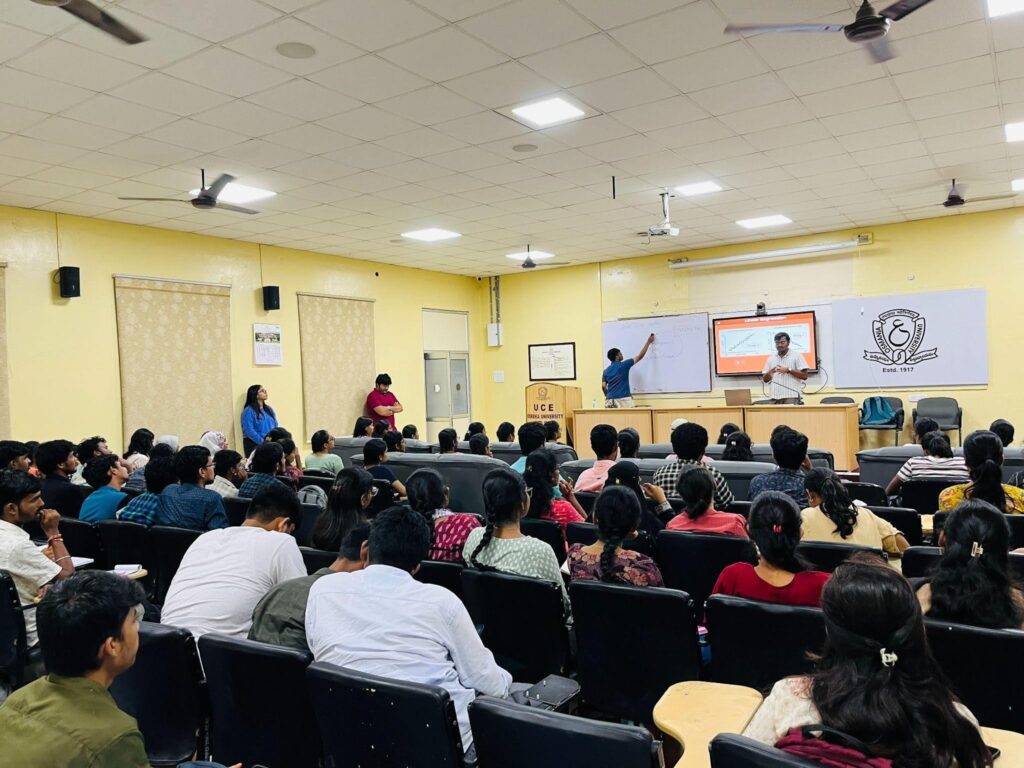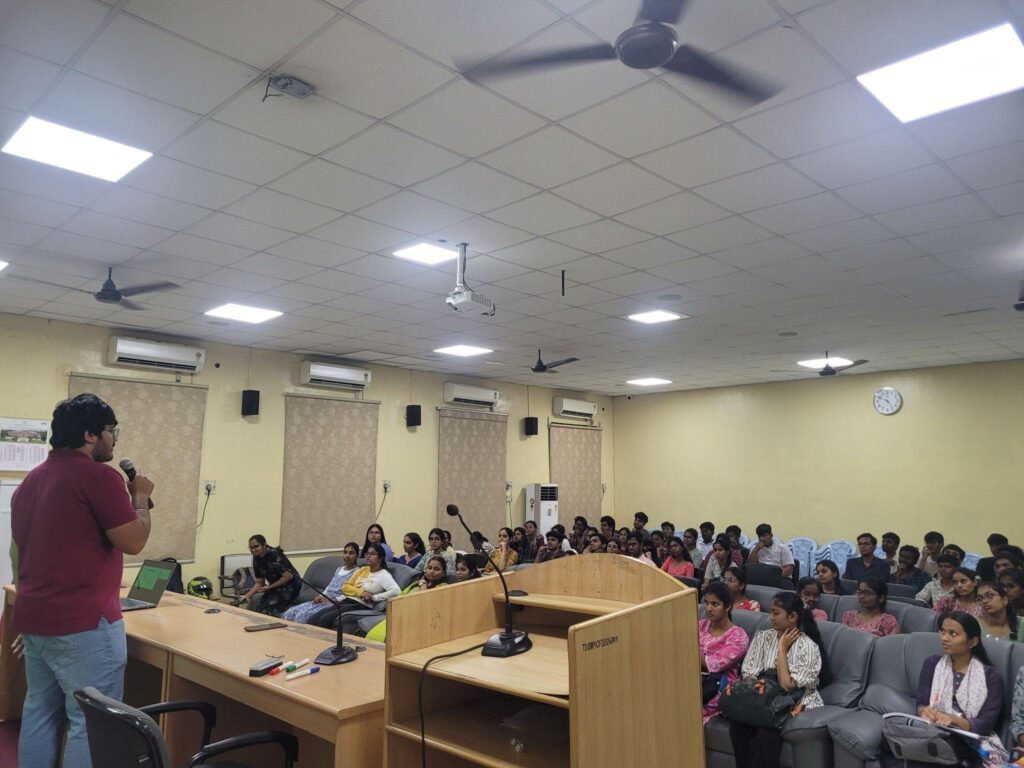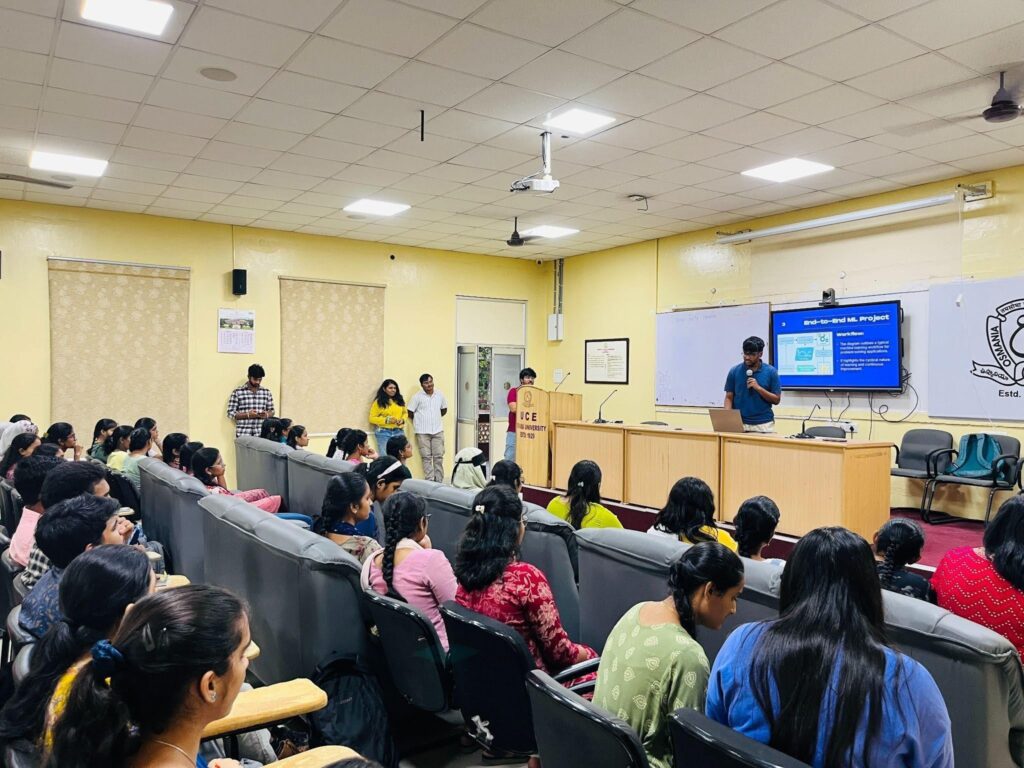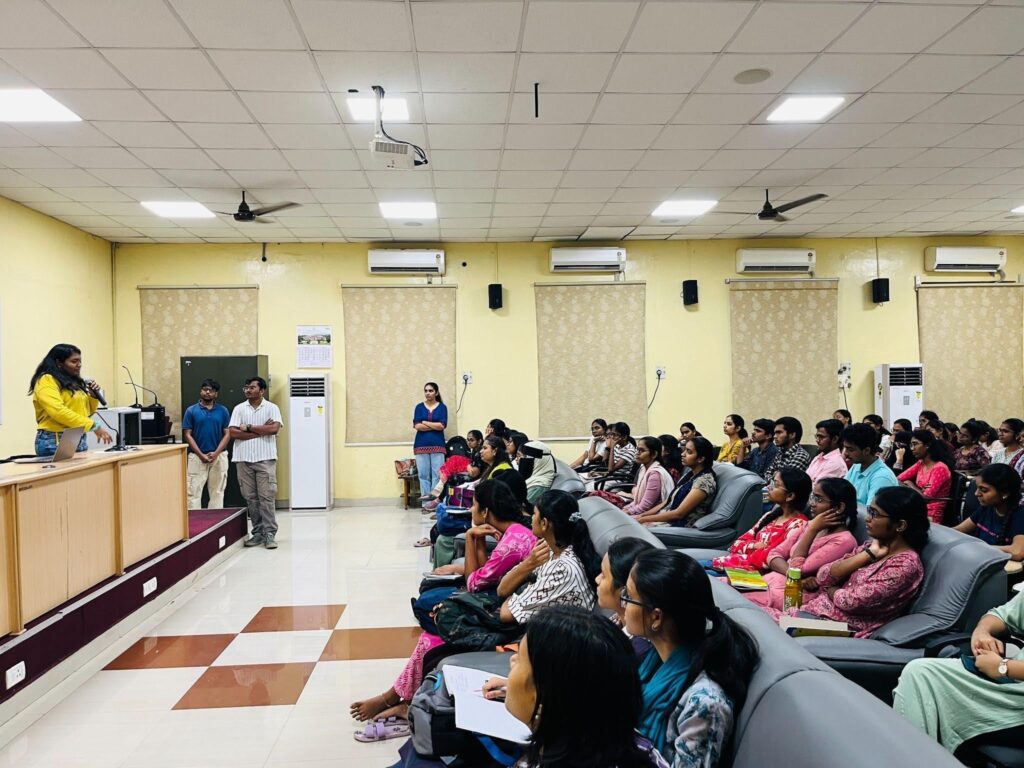

Date: 10th Sept 2025, 4:00pm – 6:00pm
Venue: Civil E Classroom, Department of Civil Engineering, UCEOU
Organized by: IEEE Computer Society, UCEOU Student Branch
Speakers:
C. Manognan and Praket, Third-Year CSE Students, UCEOU
Number of Attendees: 95 students
Event Overview:
The IEEE Computer Society, UCEOU successfully organized “Think Like a Machine – Day 1”, an interactive and insightful session focused on introducing students to the fundamentals of Machine Learning (ML). The session was led by C. Manognan and Praket, third-year students from the Computer Science and Engineering department.
Topics Covered:
1. Introduction to Machine Learning
The speakers began with a brief history of Machine Learning, tracing its origins to Arthur Samuel (IBM, 1959) who coined the term and created one of the earliest ML programs for checkers. The discussion then progressed to Geoffrey Hinton’s breakthroughs in 2006, which revived interest in deep learning and laid the foundation for modern AI applications such as search engines, speech recognition, recommendation systems, and autonomous vehicles.
2. The Machine Learning Landscape
The concept of machine learning was defined as programming computers to learn from data rather than being explicitly programmed.
Different paradigms of ML were explained:
- Supervised Learning: Classification and regression tasks.
- Unsupervised Learning: Clustering and association problems.
- Self-Supervised Learning: Representation learning (e.g., BERT, GPT, SimCLR).
- Reinforcement Learning: Learning through rewards and trial-and-error (e.g., AlphaGo, robotics).
Real-world applications like tumor detection, chatbots, and algorithmic trading were also discussed to help participants connect theory with practice.
3. End-to-End ML Project Workflow
The speakers emphasized that machine learning is an iterative process, highlighting the complete cycle:
Problem Definition → Data Collection → Model Training → Deployment → Evaluation → Improvement.
They stressed the importance of continuous iteration and refinement in real-world ML projects.
4. Linear Regression
Participants were introduced to one of the foundational algorithms in ML — Linear Regression — used to model the relationship between dependent and independent variables. Key concepts such as coefficients, residuals, and R² score were explained with examples like predicting height from weight.
5. Gradient Descent
The concept of Gradient Descent, an optimization algorithm for minimizing error functions, was discussed. The speakers demonstrated how step sizes adjust dynamically as the model approaches the minimum error, ultimately converging to the least squares solution.
6. Model Training and Implementation
A brief walkthrough of practical model implementation was provided, with reference to a GitHub repository containing example codes for linear regression and gradient descent.
Key Takeaways:
- Machine Learning is about extracting patterns from data, not merely storing it.
- Each ML paradigm addresses distinct problem types.
- Real-world ML involves iterative improvement through data refinement and model evaluation.
- Linear Regression forms the foundation for understanding complex modeling techniques.
- Gradient Descent generalizes optimization methods used across ML algorithms.
Additional Notes and Resources:
Participants were encouraged to revisit the provided slides and refer to Aurélien Géron’s Hands-On Machine Learning for deeper understanding. The speakers also shared additional YouTube resources and advised attendees to reach out for further clarification or guidance.
Conclusion:
The first day of the “Think Like a Machine” series provided participants with a solid introduction to the world of Machine Learning. The interactive approach, combined with clear explanations and relatable examples, ensured that attendees gained a strong conceptual foundation. The event concluded with an engaging Q&A session, leaving participants eager for the upcoming sessions in the series.